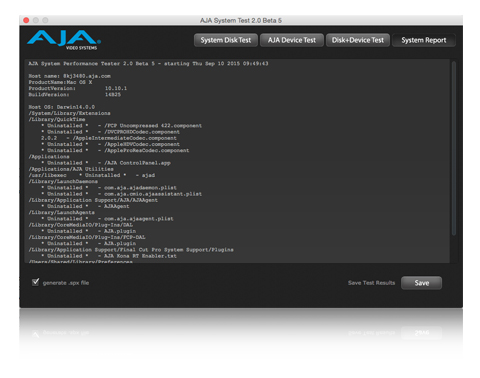
Free download hdd test mac Files at Software Informer. The HddSpeedTest utility will offer two methods to test your drives speed. A high drive speed is essential for good performance. The Aja System Test Write scores were a little slower with the Hitachi drive connected directly to a USB 3.0 port on the MacBook Pro—107.2 MBps; through the Belkin hub, the score was 106.1 MBps. AJA System Test Tune your system to the same high standards that developers do for the best performance. AJA QTToDPXTranslator and AJA DPXToQTTranslator Take a 2K or HD 10-bit RGB QuickTime movie captured with your KONA 3G and translate it to file-per-frame DPX or accomplish the opposite. Work in realtime with DPX source files within Final Cut.
Screenshots
Description
To repeat the test, click “Run the test again” or press Command-R. To restart your Mac, click Restart or press R. To shut down, click Shut Down or press S. To get information about your service and support options, make sure that your Mac is connected to the internet, then click ”Get started” or press Command-G.
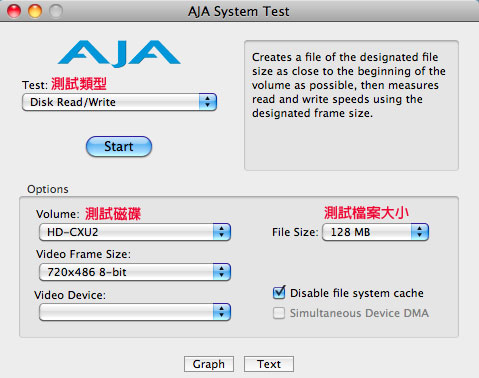
AJA System Test Lite is a great way to test a storage system with a real world speed test. Designed with digital video production and post production needs in mind, it emulates the writing and reading of video files to and from a hard disk and displays the results in a simple, easy to read format, by either data rate or frame rate, including graphs to show performance over time.
Users can specify resolutions, color spaces, bit depths, compression types and file container types, to emulate their specific digital video production/post workflow, and do preliminary evaluation to see if their storage system will support it, before practical workflow testing begins.
5 Ratings
Great tool for testing disk/SD/MicroSD/USB etc speed
This is a great tool for testing speed of drives, be it SSD, flash, USB, etc. It is easy to use and displays the result is nice graphical and stats format.
12.9 MB
Compatibility- Mac
- Requires macOS 10.6.6 or later.
Age Rating4+PriceFreeSupports
Aja System Test Mac
Up to six family members will be able to use this app with Family Sharing enabled.
If you think your Mac might have a hardware issue, you can use Apple Diagnostics to help determine which hardware component might be at fault. Apple Diagnostics also suggests solutions and helps you contact Apple Support for assistance.
Prepare your Mac
- Shut down your Mac.
- Disconnect all external devices except keyboard, mouse, display, Ethernet connection (if applicable), and connection to AC power.
- Make sure that your Mac is on a hard, flat, stable surface with good ventilation.

Start Apple Diagnostics

Determine whether you're using a Mac with Apple silicon, then follow the appropriate steps:
Apple silicon

- Turn on your Mac and continue to press and hold the power button as your Mac starts up.
- Release when you see the startup options window, which includes a gear icon labeled Options.
- Press Command (⌘)-D on your keyboard.
Intel processor
- Turn on your Mac, then immediately press and hold the D key on your keyboard as your Mac starts up.
- Release when you see a progress bar or you're asked to choose a language.
View the test results
Apple Diagnostics shows a progress bar while it's checking your Mac:
When testing is complete, Apple Diagnostics shows the results, including one or more reference codes. Learn about Apple Diagnostics reference codes.
To repeat the test, click “Run the test again” or press Command-R.
Aja System Test Mac Os X
To restart your Mac, click Restart or press R.
To shut down, click Shut Down or press S.
To get information about your service and support options, make sure that your Mac is connected to the internet, then click ”Get started” or press Command-G. Your Mac will restart to a webpage with more information. When you're done, choose Restart or Shut Down from the Apple menu.
Learn more
On an Intel-based Mac, if you can't start Apple Diagnostics with the D key, try these solutions:
- Press and hold Option-D at startup to use Apple Diagnostics over the internet.
- Make sure that your Mac isn't using a firmware password.


