


- What is Camarilla Calculator? This formula was introduced in 1989 by a UK bond trader named Nick Stott. The Camarilla Equation in calculates ten levels of intra-day support and resistance according to yesterday’s High, Low, Open and Close. There are 5 of these “S” levels below yesterday’s close, and 5 “R” levels above.
- Advanced Camarilla Pivot Calculator If you don’t have the Camarilla pivot points indicator, we recommend using the Camarilla calculator HERE. What we like about this Camarilla pivots calculator is the fact that it comes with an extra two levels of resistance (R5 and R6) and two extra levels of support (S5 and S6).
- I can't seem to get the TOS-made Camarilla points to calculate correctly so I redid it. I removed the aggregation periods and now it only uses the previous day data. I have scripted the actual formula but need some help aligning the calculated points (on left axis) with the actual price (on right axis).
- Apr 07, 2013 Remember, this is a very basic look at the Camarilla Equation. Much like the other forms of price-based indicators I use, the Camarilla Equation lends itself perfectly for higher levels of analysis, like pivot width analysis, pivot trend analysis, and two-day pivot relationships.
Since levels 5 and 6 formulas are kind of surrounded in mystery it's difficult to find a widely agreed one. While for the level 5 there is some consensus the 6th one is hard to find. I updated level 5 with the most common use of lvl 5 formula, some links like this one or from books (Secrets of a Pivot Boss). Level 6 is a tough one, so please use this one experimentally. If you have other.
Today, I want to talk about a new indicator we have introduced on the Market Pulse app that happens to be one of my favorites and one that you can depend upon for your intraday trading - the Camarilla Pivots.
This article will cover :
- What is Camarilla Pivots
- Benefits of Pivot Trading
- Camarilla Calculations
- Camarilla Trading Strategies
- Benefits of Pivot Trading
- Display of Pivots on Chart
Camarilla Pivots
Most of you are already aware of the Standard and Fibonacci Pivots used widely for intraday trading. The basic building block of these levels are that prices have a tendency to revert to their mean and the trader can use them to make the right entries and exits for profitable intraday trading.
In the classic pivots, traders watch Resistance 1 and support 1 as the crucial levels. In Camarilla Pivot points, traders attach importance to third and fourth levels of Support and resistances as shown in the Fig.
Benefits of Pivot Trading
- Prepares the trader in advance with a game plan.
- Levels are generated automatically each trading day.
- Spots trigger points in bullish and bearish areas of the chart
- Clear entry and exit points.
- Identifies support and resistance;
Calculator
Camarilla Calculations
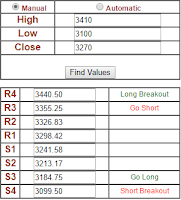
Feel free to skip this section if the math doesn’t excite you.
The input parameters for Camarilla calculations are the Previous days Open, High, Low and Close.
The levels are calculated as follows:
R4 = Close + (High – Low) * 1.1/2
R3 = Close + (High – Low) * 1.1/4
R2 = Close + (High – Low) * 1.1/6
R1 = Close + (High – Low) * 1.1/12
S1 = Close – (High – Low) * 1.1/12
S2 = Close – (High – Low) * 1.1/6
S3 = Close – (High – Low) * 1.1/4
S4 = Close – (High – Low) * 1.1/2
Once a security either moves above R4 or below S4, means a breakout move and a trending move is likely towards R5/R6 on the upside and S5/S6 on downside which are calculated as follows:
R5 = R4 + 1.168 *(R4-R3)
R6 = (High/Low)* Close
S5 = S4 – 1.168 *(S3-S4)
S6 = Close – (R6 – Close)
Display of Pivots on Chart
As a user of Pivots, you must be aware that the Pivot points displayed on your chart are calculated based on different data points.
For eg. If you are using an intraday chart up to 15 minutes, the pivot points are calculated based on the open, high, low, close of the previous trading day. If the chart setting is 30 minutes to 4 hours, the pivot points are calculated based on the open, high, low, close of the previous trading week’s data and similarly for daily charts the pivots are from the previous monthly candlestick data.
Camarilla Trading Strategies
There are 4 distinct scenarios that can occur when trading with Camarilla pivots:
- Scenario 1 - Open price is between H3 and L3
- Scenario 2 - Open price is between H3 and H4
- Scenario 3 - Open price is between L3 and L4
- Scenario 4 - Open price is outside H4 and L4
Scenario 1
Open price is between H3 and L3
For Long
Wait for the price to go below L3 and then when it moves back above L3, buy. Stoploss will be when price moves below L4. Target1 - H1, Target2 - H2, Target3 - H3
For Short Sell
Wait for the price to go above H3 and then when the price moves back below H3, sell. Stoploss will be when price moves above H4. Target1 - L1, Target2 - L2, Target3- L3
Camarilla Advanced Calculator Formula Sheet
Scenario 2
Open price is between H3 and H4
For Long
When price moves above H4, buy. Stoploss when price goes below H3. Target 1 - H5, Target 2 - H6
For Short Sell
When the price goes below H3, sell. Stoploss when prices moves above H4. Target1 - L1, Target2 - L2, Target3- L3
Scenario 3
Open price is between L3 and L4
For Long
When price moves above L3, buy. Stoploss when price moves below L4. Target1 - H1, Target2 - H2, Target3 - H3
For Short Sell
When the price goes below L4, sell. Stoploss when price moves above L3. Target 1 - L5, Target 2 - L6
Scenario 4
Open price is outside the H4 and L4
Wait for the prices to come in range and trade accordingly.
Conclusion
Patience and discipline are key. Traders must wait for the levels to be reached before taking action. Once you are comfortable with trading the basic strategy, you can further experiment by combining it with SMA, EMA or the RSI to see if you can further improve your trading performance.
Trivia
Camarilla Pivot points was discovered by Nick Scott in 1989, a successful bond trader.
Famous Nick Scott Quotes
'If it ain’t broke, don’t fix it!
“Do the same dance as everyone else, just learn how to sit down BEFORE the music stops!'
'Most traders go broke because they can't adapt. They think they have found the'secret', and may even make money for a while, but then suddenly it stops working. They don't adapt, they just keep on trying the same old(now non-functional) trick until they run out of cash. The reason I'm Nick Scott and you are not is that I adapt on a daily basis. Adapt or die!”
Market Pulse is now available on iPhone
11. Camarilla Trading
We discuss here the fundamental approach of Camarilla trading and also present useful Amibroker AFL's that are immediately usable.
The Camarilla based trading system is a level based classic system which postulates that market moves around a mean level which is determined by the previous days prices. There have been various stories of how it was invented, and we wont get into that but explore the system straightaway. For a trader who wants to trade consistently with decent and moderate profits, this is one of the most consistent systems which works well for high volume financial instruments. It works well with the various indices and particularly in the forex market too.
The market mean for the trading day is the close of the previous day and trading levels are derived from the High and Low of the previous day.
There are four key levels that are important:
The resistance - the price to which an initial long will be successful.
The long breakout - the price above which the market is in a major long trend
The support - the price to which an initial short will be successful and,
The short breakout - the price below which a short trend will occur.
The above is the basic explanation of the Camarilla levels. Most internet resources tend to complicate the definition to make it unusable to a large extent.
See the chart aboveand the definitions of the Resistance R1 and R2 and Support levels.S1 and S2.
If H, L and C are the high, low and close of the previous day, the factors that go into it are:
Price momentum = High - Low = lets call it momentum.
Market mean = Close = Mean.
Resistance/Support factor = RS = 0.275 an optimized number.
Breakout factor = BF = 0.55, another optimized number.
So Resistance = Mean + Momentum x RS
and Support = Mean - Momentum x RS
or R1 = C + (H-L) x 0.275
and S1 = C - (H-L) x 0.275
Likewise, the breakouts are nothing but
Long Breakout = Mean + Momentum x BF
Short Breakout = Mean - Momentum x BF
or R2 = C + (H-L) x 0.55
and S2 = C - (H-L) x 0.55
You can see that by reading the principles in the way described, it is intuitively possible to understand how the inventor wanted to express himself.
Note the relationship between the Breakout factor and the Resistance/Support factors. The former is double the value of the latter. In fact, if you examine more closely, there is a relationship between Camarilla levels and the Fib Levels too. The Resistance level for example is very close to the 61.8% retracement level.
11.1 Trading with the Camarilla Levels
Approach 1 -
Long positions entered ABOVE support (S1) and ABOVE resistance (R1) and ABOVE long breakout (R2)
Short postions entered BELOW support (S1) and BELOW resistance (R1) and BELOW short breakout (S2)
and Approach 2 -
Long positions are entered ABOVE support (S1) and ABOVE long breakout (R2) only and
Short positions are entered BELOW resistance (R1) and BELOW short breakout (S2) only.
Whats the difference. Approach 2 will generally give more modest profitable trades, but it avoids possible whipsaws that occur sometimes between resistance and breakout levels and support and breakout levels. You can experiment and use either of these approaches. If you are able to introduce noise cancellation for whipsaws, then Approach 1 remains more superior.
11.2 Real Trades with the Camarilla levels
Important approach to increase profits: Add to positions when a new entry position is crossed
Long initiated at S1. Add to positions at Long entry at R1 and add more at cross of R2.
Short initiated at R1. Add to positions below S1 and below R2.Exit based on targets and trailing stop losses.
Setting up exit targets. While the system does suggest targets for longs and shorts, you must set up your target strategy based on a risk reward approach.Example:If your stop loss is 15 points while trading the Nifty. Your risk reward ratios can be 1:1, 1:2, 1:3 and 1:4. So your target exits are 15 pts, 30 pts, 45 pts and 60 pts. Use risk reward levels crossovers as trailing stop losses. Which means you fail to cross 1:3 and price falls, you exit at 1:2 level i.e. 30 points. Makes trading really simple!Another approach is to set up trailing stop losses (SL) at a standard level of say 20 - 25 points. Increasing trailing SL's increase your ability to stay with the trade but reduces the profit on exit. Its best to combine target based and trailing stop loss based exits through your own experimentation.
11.3 Setting up exit targets based on Camarilla levels
High Target 1 = R2 + 1.005 x R2 (.05% level)
High Target 2 = R2 + 1.01 x R2 (.1% level)
Low Target 1 = S2 / (1+.005) (0.05% level)
Low Target 2 = S2/(1+0.01) (0.1% level).
Likewise you can peg targets for longs and shorts starting at S1 and R1 respectively as:
Long Target 1 = S1 + 0.65 * (R1-S1) and
Long Target 2 = S1 + 0.85 * (R1-S1) and
Short Target 1 = R1 - 0.65 * (R1-S1) and
Short Target 2 = R1 - 0.85 * (R1-S1)
Alternative targets for highs and low breakouts are -
BTHigh = High/Low x Close
BTLow = Low/High x Close
In conventional common references, the R1, R2 and S1 S2 levels described here are correlated to H3, H4 and L3,L4 levels respectively or to R3,R4 and S3,S4.
An AFL for trading with the Camarilla system is attached below.
We will modify this to suppress some of the unneccessary target lines.
Rev 7.1.2011 - Parameters added to allow user to display or suppress inner and outer targets. Please Choose the target option when Outer target parameter is set to display targets. Also you can now vary the CAM parameters themselves. Use with care, as the standard levels work well in most situations.
Rev 30.11.2014 - Bar repainting within current time period fixed and improved logic for whipsaw removal implemented. Parameters introduced to control the period of the slow and fast moving lines and a distance from crossover in terms of bars to avoid delayed signals.
Camarilla Advanced Calculator Formula 1
| camarilla_plot_30-11-2014.afl | |
| File Size: | 7 kb |
| File Type: | afl |
 Download File
11.4 Alternative strategies for setting up Camarilla levels
(Contributed by JR Julius - http://everydayprofits.blogspot.in/)
Few days the Open will be Above H4 or Below L4 Due to GAP. In these situations I put the today open in the place of previous day close in the Camarilla formula. That means Close is replaced by Open of the day the gap up occurred.
#Approach2 - Alternative entries after opening
You missed the entries during opening. Take H/L/C as the values after one hour. Use the R2 (H4) and S2 (L4) levels for trading only. Which means you go long above R2 and short below S2. Thats it. And work with a 1:1 risk reward trade.
Alternative comment : (Abnash): Consider Camarilla set ups with 2 hours and 4 hours and even weekly/monthly levels and you can get trading opportunities there too. Paper trade first.
#Approach3 - Market opens at the close of the previous day i.e. the mid point for today
Market Opens in the Central Point. Means In between L1 & H1. H3 May Act as Buy. L3 May Act as Sell. It can be done with the guidance of experts using few technical indicators. This one is weird may damage total understanding about camarilla, but if one watch the camarilla levels alone for few months will automatically understand what I am saying here.
Comment (Abnash): The method described in this section uses R1/H3 as a buy or sell in the right context.