


Using a photo editor app can help you edit your photos with ease and allow you to create high-quality small size images to share on the web.
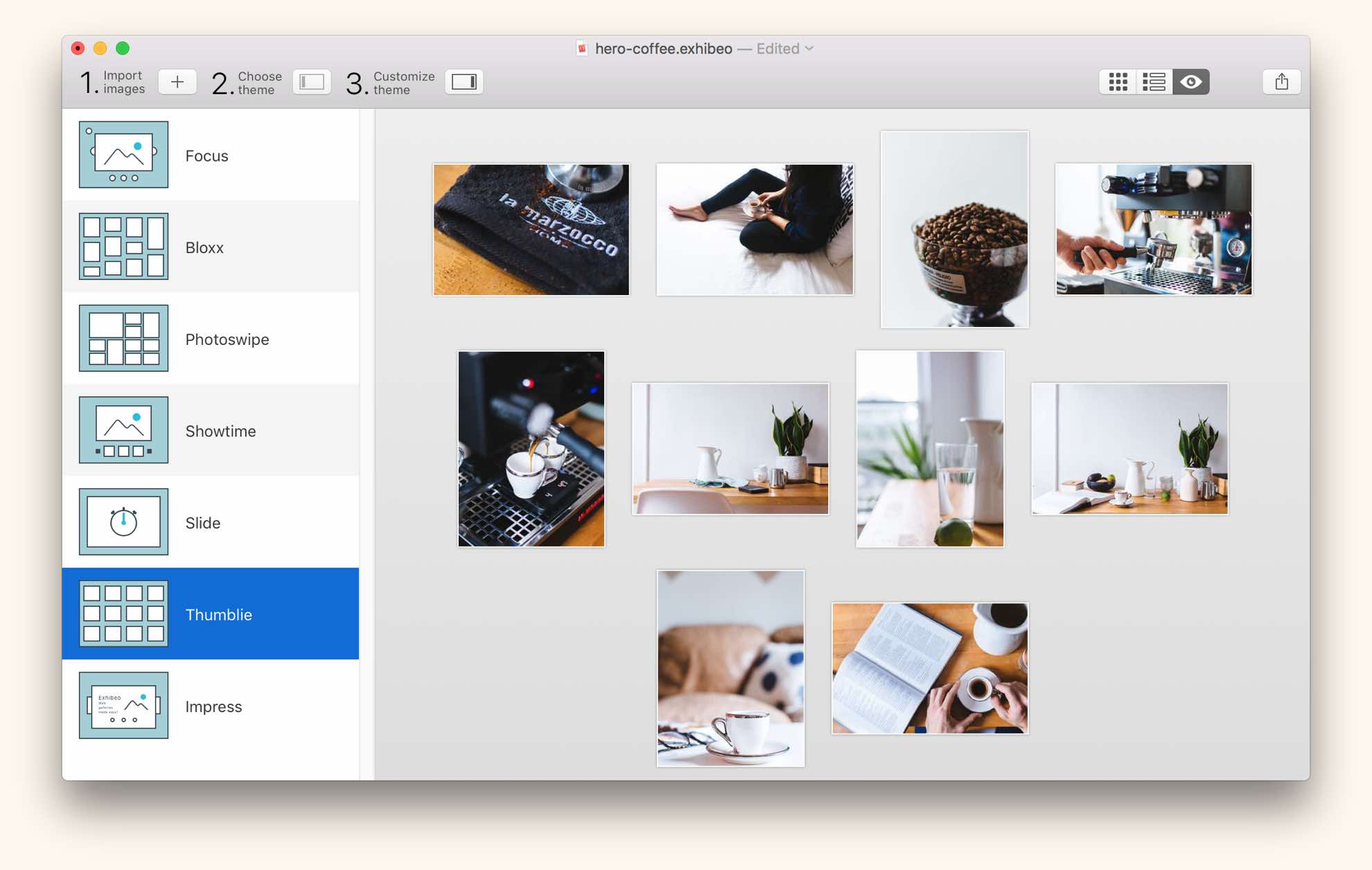
- Exhibeo 2 Easy-to-use Web Gallery Application
- Exhibeo 2 Easy-to-use Web Gallery App Download
- Exhibeo 2 Easy-to-use Web Gallery App
- Fast drawing for everyone. AutoDraw pairs machine learning with drawings from talented artists to help you draw stuff fast.
- May 31, 2016 - UK based Softpress today releases Exhibeo 2, an important update to their popular photo gallery and slideshow creation tool for Mac. Designed exclusively for OS X Yosemite and El Capitan, Exhibeo 2 allows web designers and creatives to quickly and easily generate HTML5 image presentations using a range of beautifully designed.
Exhibeo puts your images front and center, doing it with flair and style. Make your site stand out - and do it beautifully. Make your site stand out - and do it beautifully. With seven themes included, there’s a gallery for almost anything: displaying artwork, showcasing products, or keeping your group updated.
Here we will consider the list of the top 16 best free photo editing apps in 2021 to get a perfect job done:
Read on for the detailed analysis of each app.
Top 16 Best Free Photo Editor Apps
You're convinced that you want to get a photo editor software, but not sure where to start. There are many free online photo editor programs to choose from. We've narrowed down the best free photo editor that you can use without paying a hefty price.
1. Adobe Photoshop Express Editor
Best Photo Editing Software Overall
Although Photoshop can be a bit intimidating, its sister product Adobe Photoshop Express Editor is an altogether different animal. All the tools are readily accessible and easy to use.
Adobe Photoshop Express Editor is a free photo editor. It is jam-packed with features that will allow you to make your images pop. You will be able to remove red-eye, resize images, make color corrections, and more.
It works right from your browser or mobile app. Editing photos is a snap with tools to balance color, resize, crop, change lighting, rotate, and more. The interface is appealing yet user-friendly. Our only gripes are that it was designed in Flash and not HTML5, and image formats can be somewhat limited.
👆 Special Features:
- Crop
- Rotate
- Remove Red and pet-eye
- Auto-Fix
- Text Tool
- Blemish Removal
- Corrections
- Customization
- Perspective Correction
- Pop-Color Tool
- Image Resize
- Watermark Images
- JPEG Quality Output
- Looks
- Borders
✅ PROS:
- Simple and complex customization
- Easy to use
- Compatible with other Adobe Products
- Gives you the edits you need to improve photos significantly
⛔️ CONS:
- Some features require creative cloud membership that has a fee
- The photo organizer tool is a separate app
2. Canva
Best Photo Editing App for Social Media
Canva is an easy to use photo editor app that allows users to create graphics and edit photos by merely dragging and dropping. It takes no time at all to build a design from scratch, and you don't have to be a pro to learn how to use this free photo editing software. It has tons of features that will help you create the ultimate design or touch up your pre-existing photos.
One of the best features of Canva is its extensive library of templates. Within minutes you can drop your photos into a preset layout and then style it using dozens of fonts, illustrations, graphics, colors, and design elements.
With Canva, you can create stunning pieces quickly that you can share, print, or export. This online photo editor also comes complete with built-in support using search, tabs, and articles to find help with any issue.
👆 Special Features:
- Photo Straightener
- Image Cropper
- The Ability to Add Text
- Speech Bubble Maker
- Transparency Tool
- Photo Enhancer
- Photo Blur
- Photo Vignette
- Design Grids
- Free Icons
- Photo Frames
- Web Wireframe
- Stickers
- Badges
- Add Texture
✅ PROS:
- Great for marketing photos on social media
- Make and design ebooks
- Excellent for web presentations
- Tons of great features for free
- Saves project history
⛔️ CONS:
- Unable to remove an image’s background
- Needs to increase font size
3. Resizing.app
Best Photo Resizer
One of our favorites is an online image resizer, called Resizing.app. The company has a straightforward website and process to resize images online within seconds. One of the coolest features is the ability to export your newly sized image into a different format.
Resizing.app couldn’t be easier to use. You simply drag and drop your images into the box on the home page. Then you select how you want to resize your image (by width, by height, custom size, by percentage, or by the largest side of the image). You can choose to compress your image for quality assurance and then just pick your new file format (jpg, png or webp). Once you hit the save button, your new image is saved to your computer. Voila’ all done. No frills but also no hassles.
Unfortunately, this online service does not have any additional photo editing capabilities to go along with resizing. But hey! It’s free, and we like free and simple.
If you resize your images and photos regularly, we highly recommend you to add the Resizing extension to your Google Chrome; it is also entirely free.
👆 Special Features:
- Resizing by width, by height, custom size, by percentage, and by the largest side of the image.
- Compress a photo
- Crop an image
- Convert an image to JPEG, PNG, WEBP
- Optimize a picture
✅ PROS:
- Free
- Easy to use
- Online
- Convert TIFF and HEIC files into JPEG, PNG or WEBP
- Has extention for Google Chrome
⛔️ CONS:
- Doesn't have any additional photo editing capabilities
4. inPixio
Another app we tested looking for the best free photo editor was inPixio. In reviews, inPixio earns high marks for usability, features, support, speed, and pricing. It has some fantastic tools to fix perspective (straighten buildings), image correction, dehaze, and you can even edit metadata right within the app to add headlines, captions, and copyright details.
inPixio also offers a free tool to remove the background from an image. It works pretty well if the photo has a clear color distinction between what you want to remove and what you want to keep. inPixio is fun to use, although it may not rank as the best free photo editor on the block, it is worth checking out.
To purchase the full program, you will need to select either the inPixio Photo Studio 10 for $49.99 or inPixio Photo Studio Professional version for $59.99. The price is for the full software you can install and use on your Mac or Windows PC.
Looking for one for your Mac? Read our review of the best mac photo editor.
👆 Special Features:
- Eraser
- Correction Patch
- Cloning stamp
- Cutter
- Retouching and Correction
- Perspective correction
- Film grain module
✅ PROS:
- Tools for retouching photos, resizing, removing backgrounds, cropping, fixing sharpness, trimming, and adding filters.
- Share images within the app.
- Erase objects easily from photos.
- No ads.
- It doesn’t “push” you to upgrade.
- Special effects to enhance your images.
⛔️ CONS:
- The background removal tool doesn’t always yield perfect results.
- Some users complain that it does not work as advertised.
- Puts watermarks on images with the free version.
- Cannot batch edit.
- Works by installing multiple modules.
5. Instasize
If you are in the market for the best free photo editing app, you will want to check out Instasize. The app was designed for social media and influencers who want to create eye-catching, creative photos, and videos for their social feeds. The software includes dozens of visually stunning filters, color editing tools, and you can even edit your videos with it.
Instasize has a broad fan base of more than 500,000 users. The plethora of editing tools also include photo retouching features, fonts, and text editing. The free version is limited, but if you are willing to pay $4.99/month, the Premium version is loaded with goodies.
👆 Special Features:
- Collage maker
- Naturally enhancing filters
- Advanced editing adjustments
- Borders
- Beauty tools: edit blemishes, whiten teeth, remove redness, etc.
- Social media formats
- Pro fonts and text editor
- Video editing
✅ PROS:
- Geared toward creating engaging content for social media.
- Dozens of useful features, including backgrounds, beauty enhancements, borders, and filters, to make content creation easy.
- Create collages in a snap.
- Automatic resizing for social media formats.
- Fast and easy to use.
⛔️ CONS:
- The free version is stripped down and includes ads.
- Some users complain about the ads and some glitches.
- Only works on mobile devices, no app for PC or Mac.
6. Adobe Photoshop Lightroom
A well-known name in the photo game is Adobe, which makes dozens of photo enhancement and editing products. One such app is the Adobe Photoshop Lightroom app.
This product is a cloud-based product where you can upload batches of images and edit them together. It wouldn’t be from Adobe without excellent photo editing tools built-in, and if you run into trouble, they have online tutorials to walk you through it all.
You can edit photos easily with all the expected features, share photos, take pictures from inside the app and sync them across all your devices. The Premium version cost is $9.99/month, which may be more than most users want to pay. If you want access to all the creative cloud apps, that figure balloons to $52.99/month.
👆 Special Features:
- Preset creation
- Split Toning
- Tone Curve
- Batch editing on desktop
- Camera
- Healing Brushes
- RAW Editing
- Cloud Storage
- Sync Presets & Profiles
✅ PROS:
- Runs on Mac, Windows, Android, and iOS.
- Easy to use, clean interface.
- Create albums to organize all your photos.
- Built-in presets to make editing easy.
⛔️ CONS:
- Costly to use cloud storage.
- May be too much for some users.
Exhibeo 2 Easy-to-use Web Gallery Application
7. Fotor
Best Free Photo Editing App Online
Fotor is a photo editor software that allows you to utilize its photo editing suite to create top-notch photos. In just a few clicks you can adjust the color, size, lighting and more. It also has an HDR effect for your advanced editing needs.
The magic of Fotor is its extensive library of one-click filters to enhance and liven up any photo. Although Fotor is not as powerful as Photoshop and not as feature-rich as GIMP, it holds its own with a solid set of skills such as RAW file processing, borders, frames, color enhancement, and lighting adjustments.
If you like Fotor, there is also a Pro version you can purchase. However, it only works on the Windows platform. Read our review of the best windows photo editor.
👆 Special Features:
- Image Shape
- Fonts
- Stickers
- Align
- Drop Shadow
- Transparency
- CLone
- Color Picker
- Photo Collage
- Filters
- HDR
- Beauty Retouching
✅ PROS:
- Has web, mobile and desktop version
- Smart filters and effects
- Collage maker
- Raw file converter
- Has a social network
⛔️ CONS:
- Lots of ads
- Inability to edit photos at a deeper level
- Incompatible with creating images from scratch
8. VSCO
VSCO is another contender in our line-up of the best free picture editing apps. VSCO is a minimalistic app with a simple interface and powerful features. Its best feature is the vast library of filters to enhance your images and make them share-worthy.
You can do so within the VSCO social media channel. Yes, they have their own social network but you aren’t limited to just that one. VSCO also offers some other photo editing tools such as adjusting color, balance, highlights, cropping, and spot healing. The free version is limited to only ten filters, which isn’t very many compared to the 200+ you get with the paid version. A VSCO premium membership costs $19.99/year.

👆 Special Features:
- Filters
- Clarity
- Tint
- Fade
- X-Skew
- Y-Skew
- Skin Tone
- Highlights Tint
- Shadows Tint
✅ PROS:
- Includes its own social network to share images.
- Easy to use interface.
- Excellent editing tools with the paid version.
- Powerful camera features like ISO, exposure, white balance, and focus.
- Save images in RAW format.
- Video editing.
- Create montages easily.
- The ability to share from within the app.
⛔️ CONS:
- Requires a paid subscription for the best features.
- Only works on mobile devices, no app for PC or Mac.
- Not as good for social media image creation.
- Pushes upgrading.
- No option to take selfies with the app.
- No zoom features.
9. BeFunky
BeFunky is much more than just a free photo editor. With easy to use features, this photo editor app provides high-quality results whenever you use it to edit photos or make collages. You’ll have fun using this software for years to come.
Using the myriad of free collage layouts and design elements, you can quickly create a new Facebook banner or other social media image. The program is an online photo editor but also supports a handy mobile app. Integrations allow you to save your masterpiece to Dropbox or Google Drive and share it on Facebook, Pinterest, or Twitter. BeFunky’s drag-and-drop functionality makes it a breeze to use.
👆 Special Features:
- Collage
- Crop
- Resize
- Digital Art
- Cartoonizer
- Enhance DLX
- Font Pairing
- Create Wallpapers for Your Device
- Edit and Replace Colors
- Batch Processing
✅ PROS:
- Complete control of your work
- Easier than most programs to use
- Privacy
- Editing tools have variety
⛔️ CONS:
- No eraser tool
- Additional content has a cost
10. Pixlr
You can’t beat the convenience factor of a powerful photo editor that runs in your browser, and Pixlr delivers. Pixlr is a great way to have a convenient photo editor at your fingertips that is user-friendly and can provide the professional-looking images you imagined.
Pixlr is a Photoshop clone that offers a generous treasure trove of image-editing features along with the ability to import photos from Facebook. Pixlr has also been compared to GIMP in terms of functionality and user interface. Although it may be overkill for some, it’s just the right balance of form and functionality for others.
👆 Special Features:
- Edit Photos Using Dropbox
- Layers
- Filters
- Adjustments
- Texts
- Fonts
- Magic Wand
- Lasso
- Brushes
- Eraser
- Object Transform
- Color Replace
- Digital Painting
- Image Retouching
- Digital Inking
- Photo Collage
- Effects
✅ PROS:
- Available on desktop and mobile
- Supports layers and masks
- Customize the interface
⛔️ CONS:
- Some ads
11. Snapseed for Android and iOS
Best Photo Editing App for Professional Photographers
Snapseed is a free online photo editor designed for the serious photographer who wants to enhance their photos professionally. Its primary focus is on providing filters that will change the effects. You can also share your creations with its export tool.
The software uses stacks/layers of edits so you can remove, arrange, or apply them at will. These stacks can be saved as a “look,” meaning a style which you can then use to apply to other photos. Compared to other apps, Snapseed shines with an impressive array of filters, brushes, and nondestructive editing tools that will delight any serious photo editing buff.
👆 Special Features:
- Pre-Made Filters
- Looks
- Tools
- Export
✅ PROS:
- Nondestructive editing
- Selective edit brushes
- Photographic filters
⛔️ CONS:
- More suitable for experienced users
- No auto-save
12. PhotoScape

PhotoScape was designed for the beginner, but don’t let that fool you; it is a powerhouse of features and functionality. Although the layout of PhotoScape is a bit clunky, the tools are solid, and along with retouching features, you can easily add filters to your images, create animated GIFs, batch edit photos, create slideshows and more using dozens of free templates.
The list of accolades is impressive for a free photo editor app.
PhotoScape gives you the ability to create stunning images with access to multiple tools. Enhancing your photos becomes more convenient, and you aren't disappointed by a system that doesn't deliver. It has your basic features and more advanced ones such as Batch Processing, Font pairing, and Digital Art.
👆 Special Features:
- Viewer
- Editor
- Batch Editor
- Page
- Combine
- Animated GIF
- Splitter
- Screen Capture
- Color Picker
- Rename
- Raw Converter
- Paper Print
- Face Search
✅ PROS:
- Plenty of Features
- Effects Preview
⛔️ CONS:
- Redundant Interface
13. Paint.NET
Paint.Net started as a built-in program on the Windows platform and evolved into its own standalone photo editing software with an innovative user interface that supports many features. This photo editor can be extended through plug-ins to give a wide variety to what the photo editor app can do.
While it provides a clean layout and powerful tools, this program is not for beginners. It boasts of a main working window with the tools corralled into their own movable windows. The program uses layers to keep everything organized. A design aficionado will be disappointed with the lack of some features, but for most users, it’s a great solution.
👆 Special Features:
- Layers
- Unlimited Undo
- Special Effects
- Powerful Tools
- Unlimited History
✅ PROS:
- Innovative Interface
- Keyboard Shortcuts for Tools and Menu Items
- Font Previews
⛔️ CONS:
- Little Control Over Text
- Minimal Layer Effects
- Few Brush Options
14. GIMP
Best Open-source Photo Editor
GIMP is open-source software and a favorite among many graphic designers. GIMP has often been compared to Photoshop. While it shares many of the same features and functionality of the popular photo editing software, GIMP is free.
Some of the highlights are a plethora of brushes to choose from, filters, and even plugins to make the software more desirable. GIMP also supports animation. Because of all this, GIMP is by far our pick for the best free photo editor.
👆 Special Features:
- Color Correction
- Skin Retouching
- Eyes Brightening
- Customizable Interface
- Graphic Design Elements
- Original Artwork
- Photo Enhancement
- Inkscape
- Swatch booker
✅ PROS:
- Compatible With Many File Types
- Developer Support
- User-Friendly Interface
- Open Source Code
⛔️ CONS:
- Functionality
15. Photo Pos Pro
Photo Pos Pro is excellent for creating computer graphic designs and text that will pop. It is a powerful software that can be mastered by advanced and beginner photo editors. The system has a program that offers assistance for beginners who need step by step instructions.
With Photo Pos Pro, you get the best of both worlds, the choice of a beginner or expert interface. Photographers will love the support for RAW files, the many filters, and retouching tools. Both the novice and pro interfaces are a bit confusing and cluttered. It’s a very personal preference when picking the best free photo editor for you.
👆 Special Features:
- Filters
- Layers
- Masks
- Curves
- Scripts
- Effects
- Brushes
- Frames and Collages
- Text Effects
- RAW Files Support
- Remove, Erase, and Replace Backgrounds
✅ PROS:
- Great For Any Level of Experience
- Superb Help and Tutorials
- Manual Editing and Automatic One-Click Editing Balance
⛔️ CONS:
- Large Learning Curve
- Software Glitches
16. Colorcinch
Colorcinch is another great free photo editor with some advanced features that rival PhotoShop. The one-click photo cartoonizer is a fun feature to turn a photo into a cartoon and a work of art all in one. Check out this complete how-to guide to turn your photo into a cartoon.
This free photo editor app is easy to use and full featured, with the ability to use layers, overlays, artistic masks, blur, blend, frames, or eliminate blemishes. The free version works very well, but you can also pay for an enhanced version for $4-$6/month, depending on the plan you choose.
Some features are not available in the free plan, like premium filters and enhancements.The interface is super simple. Just drag and drop a photo and begin editing. People seem to love the cartoon feature; however, some users have experienced bugs. The company recently rebranded; let’s hope they upgraded the app to go with the new name.
✅ PROS:
- One-click cartoon feature.
- Layers.
- Easy to use.
- Full-featured photo editor and text editor.
- Advanced features.
- Inexpensive
⛔️ CONS:
- No batch edit feature (yet).
- Premium features not included with the free version.
How to Choose The Best Free Photo Editor?
When it comes to choosing the best photo editor software, there are many things to take into account. The top features to look at are the file formats, organizing tools, photo sharing, and standard editing tools. These items are significant for those who're interested in doing photo editing whether it is for pleasure or career.
File Formats
File formats like jpg, gif, and png are essential to have if you're uploading your photos to the Internet. These formats allow you to compress the file size of the images to publish them on the web.
Organizing Tools
Having a free online photo editor should come with tools to help keep you organized. It is essential to have features that will keep track of your photos by using thumbnail previews, search, and naming schemes.
Standard Editing Tools
Having the basics is vital to being successful at photo editing and utilizing the photo editor software of your choice. Some of the typical tools you'll need are adjusting brightness and contrast in your photos, crop, resize, and rotating the images. They should be easy to catch onto and fast to use.
Searching for how to resize images without losing quality? Follow our step-by-step guide on how to do it at no time.
Photo Sharing
We all know how eager we get to post our work and personal photos online. With the right program, it will reduce the time it'll take to upload the image online. That will decrease the need to have a photo editor software that has blogging tools to get your photos posted.
If you want to edit your photos like a PRO, check out the following presets of ours. Alternatively, you can leave it to professionals; FixThePhoto is one of the best photo editing companies to assign your photo retouching tasks.
Finding the best free photo editor is what will set you apart with your photography whether it's a hobby or your career. Choose from these free online photo editor apps to enhance your photos with a few simple clicks. The best part about photo editor online software is that you don't have to break the bank with these free, high-quality programs and can do it from any device, because they are web-based.
Related Articles:
5 Free Image Resizer Apps for You in 2020
5 Tips on How to Optimize Images for Web
Launchberg editors pick and review products independently. We may earn affiliate commissions when you purchase an item via our links—it helps support our testing.
-->You can publish your app in the Azure AD app gallery. When your app is published, it will show up as an option for customers when they are adding apps to their tenant.
Some of the benefits of adding your app to the Azure AD gallery include:
- Customers find the best possible single sign-on experience for your app.
- Configuration of the application is simple and minimal.
- A quick search finds your application in the gallery.
- Free, Basic, and Premium Azure AD customers can all use this integration.
- Mutual customers get a step-by-step configuration tutorial.
In addition, there are many benefits when your customers use Azure AD as an identity provider for your app. Some of these include:
- Provide single sign-on for your users. With SSO you reduce support costs by making it easier for your customers with single sign-on. If one-click SSO is enabled, your customers’ IT Administrators don't have to learn how to configure your application for use in their organization. To learn more about single sign-on, see What is single sign-on?.
- Your app can be discoverable in the Microsoft 365 App Gallery, the Microsoft 365 App Launcher, and within Microsoft Search on Office.com.
- Integrated app management. To learn more about app management in Azure AD, see What is application management?.
- Your app can use the Graph API to access the data that drives user productivity in the Microsoft ecosystem.
- Application-specific documentation co-produced with the Azure AD team for our mutual customers eases adoption.
- You provide your customers the ability to completely manage their employee and guest identities’ authentication and authorization.
- Placing all account management and compliance responsibility with the customer owner of those identities.
- Providing ability to enable or disable SSO for specific identity providers, groups, or users to meet their business needs.
- You increase your marketability and adoptability. Many large organizations require that (or aspire to) their employees have seamless SSO experiences across all applications. Making SSO easy is important.
- You reduce end-user friction, which may increase end-user usage and increase your revenue.
- Customers who use the System for Cross-domain Identity Management (SCIM) can use provisioning for the same app.
- Add security and convenience when users sign on to applications by using Azure AD SSO and removing the need for separate credentials.
Tip
When you offer your application for use by other companies through a purchase or subscription, you make your application available to customers within their own Azure tenants. This is known as creating a multi-tenant application. For an overview of this concept, see Multitenant Applications in Azure and Tenancy in Azure Active Directory.
Important
To publish your app in the Azure AD gallery you must agree to specific terms and conditions. Before you begin, make sure to read and agree to the terms and conditions.
The steps to publishing your app in the Azure AD app gallery are:
- Choose the right single sign-on standard for your app.
- Implement single sign-on in your app.
- Create your Azure tenant and test your app.
- Create and publish documentation.
- Submit your app.
- Join the Microsoft partner network.
What is the Azure AD application gallery?
- Customers find the best possible single sign-on experience.
- Configuration of the application is simple and minimal.
- A quick search finds your application in the gallery.
- Free, Basic, and Premium Azure AD customers can all use this integration.
- Mutual customers get a step-by-step configuration tutorial.
- Customers who use the System for Cross-domain Identity Management (SCIM) can use provisioning for the same app.
Prerequisites
You need a permanent account for testing with at least two users registered.
- For federated applications (Open ID and SAML/WS-Fed), the application must support the software-as-a-service (SaaS) model for getting listed in the Azure AD app gallery. The enterprise gallery applications must support multiple customer configurations and not any specific customer.
- For Open ID Connect, the application must be multitenanted and the Azure AD consent framework must be properly implemented for the application. The user can send the sign-in request to a common endpoint so that any customer can provide consent to the application. You can control user access based on the tenant ID and the user's UPN received in the token.
- For SAML 2.0/WS-Fed, your application must have the capability to do the SAML/WS-Fed SSO integration in SP or IDP mode. Make sure this capability is working correctly before you submit the request.
- For password SSO, make sure that your application supports form authentication so that password vaulting can be done to get single sign-on to work as expected.
- You need a permanent account for testing with at least two users registered.
How to get Azure AD for developers?
You can get a free test account with all the premium Azure AD features - 90 days free and can get extended as long as you do dev work with it: https://docs.microsoft.com/office/developer-program/office-365-developer-program
Step 1 - Choose the right single sign-on standard for your app
To list an application in the Azure AD app gallery, implement at least one of the supported single sign-on options. To understand the single sign-on options, and how customers will configure them in Azure AD, see SSO options.
The following table compares the main standards: Open Authentication 2.0 (OAuth 2.0) with OpenID Connect (OIDC), Security Assertion Markup Language (SAML), and Web Services Federation (WS-Fed).
| Capability | OAuth / OIDC | SAML / WS-Fed |
|---|---|---|
| Web-based single sign-on | √ | √ |
| Web-based single sign-out | √ | √ |
| Mobile-based single sign-on | √ | √* |
| Mobile-based single sign-out | √ | √* |
| Conditional Access policies for mobile applications | √ | √* |
| Seamless MFA experience for mobile applications | √ | √* |
| SCIM Provisioning | √ | √ |
| Access Microsoft Graph | √ | X |
*Possible, but Microsoft doesn't provide samples or guidance.
OAuth 2.0 and OpenID Connect
OAuth 2.0 is an industry-standard protocol for authorization. OpenID Connect (OIDC) is an industry standard identity authentication layer built on top of the OAuth 2.0 protocol.
Reasons to choose OAuth/OIDC
- The authorization inherent in these protocols enables your application to access and integrate with rich user and organizational data through the Microsoft Graph API.
- Simplifies your customers’ end-user experience when adopting SSO for your application. You can easily define the permission sets necessary, which are then automatically represented to the administrator or end user consenting.
- Using these protocols enables your customers to use Conditional Access and Multi-Factor Authentication (MFA) policies to control access to the applications.
- Microsoft provides libraries and code samples across multiple technology platforms to aid your development.
Some things to consider
- If you have already implemented SAML based single sign-on for your application then you might not want to implement a new standard to get your app in the gallery.

SAML 2.0 or WS-Fed
SAML is a mature, and widely adopted, single sign-on standard for web applications. To learn more about how Azure uses SAML, see How Azure uses the SAML protocol.
Web Services Federation (WS-Fed) is an industry standard generally used for web applications that are developed using the .NET platform.
Reasons to choose SAML
- SAML 2.0 is a mature standard and most technology platforms support open-source libraries for SAML 2.0.
- You can provide your customers an administration interface to configure SAML SSO. They can configure SAML SSO for Microsoft Azure AD, and any other identity provider that supports SAML.
Some things to consider
- When using SAML 2.0 or WSFed protocols for mobile applications, certain Conditional Access policies including Multi-factor Authentication (MFA) will have a degraded experience.
- If you want to access the Microsoft Graph, you will need to implement authorization through OAuth 2.0 to generate necessary tokens.
Password-based
Password-based SSO, also referred to as password vaulting, enables you to manage user access and passwords to web applications that don't support identity federation. It's also useful for scenarios in which several users need to share a single account, such as to your organization's social media app accounts.
Step 2 - Implement single sign-on in your app
Every app in the gallery must implement one of the supported single sign-on options. To learn more about the supported options, see SSO options.
For OAuth and OIDC, see guidance on authentication patterns and Azure active Directory code samples.
For SAML and WS-Fed, your application must have the capability to do SSO integration in SP or IDP mode. Make sure this capability is working correctly before you submit the request.
To learn more about authentication, see What is authentication?.
Important
For federated applications (OpenID and SAML/WS-Fed), the app must support the Software as a Service (SaaS) model. Azure AD gallery applications must support multiple customer configurations and should not be specific to any single customer.
Implement OAuth 2.0 and OpenID Connect
For OpenID Connect, the application must be multi-tenanted and the Azure AD consent framework must be properly implemented for the application. The user can send the sign-in request to a common endpoint so that any customer can provide consent to the application. You can control user access based on the tenant ID and the user's UPN received in the token.
To review specific examples, see the Microsoft identity platform code samples.
To review mobile specific examples, see:
Implement SAML 2.0
If your app supports SAML 2.0, you can integrate it directly with an Azure AD tenant. To learn more about SAML configuration with Azure AD, see Configure SAML-based single sign-on.
Microsoft does not provide, or recommend, libraries for SAML implementations. There are many open-source libraries available.
Implement WS-Fed
To learn more about WS-Fed in ASP.NET Core, see Authenticate users with WS-Federation in ASP.NET Core.
Implement password vaulting
Create a web application that has an HTML sign-in page. Make sure that your application supports form authentication so that password vaulting can be done to get single sign-on to work as expected.
Step 3 - Implement SCIM user provisioning in your app
Supporting SCIM provisioning is an optional, but highly recommended, step in building your application. Supporting the SCIM standard is easy to do and allows customers to automatically create and update user accounts in your app, without relying on manual processes such as uploading CSV files. In addition, customers can automate removing users and keeping group memberships in sync, which can't be accomplished with a solution such as SAML JIT.
Learn about SCIM
To learn more about the SCIM standards and benefits for your customers, see provisioning with SCIM - getting started.
Understand the Azure AD SCIM implementation
To learn more about the Azure AD SCIM implementation, see build a SCIM endpoint and configure user provisioning with Azure AD.
Implement SCIM
Azure AD provides reference code to help you build a SCIM endpoint. There are also many third party libraries / references that you can find on GitHub.
Step 4 - Create your Azure tenant and test your app
You will need an Azure AD tenant in order to test your app. To set up your development environment, see Quickstart: Set up a tenant.
Alternatively, an Azure AD tenant comes with every Microsoft 365 subscription. To set up a free Microsoft 365 development environment, see Join the Microsoft 365 Developer Program.
Once you have a tenant, test single-sign on and provisioning.
For OIDC or Oath applications, Register your application as a multi-tenant application. Select the Accounts in any organizational directory and personal Microsoft accounts option in Supported Account types.
For SAML- and WS-Fed-based applications, you Configure SAML-based Single sign-on applications using a generic SAML template in Azure AD.
You can also convert a single-tenant application to multi-tenant if necessary.
Step 5 - Create and publish documentation
Documentation on your site
Ease of adoption is a significant factor in enterprise software decisions. Clear easy-to-follow documentation supports your customers in their adoption journey and reduces support costs. Working with thousands of software vendors, Microsoft has seen what works.
We recommend that your documentation on your site at a minimum include the following items.
- Introduction to your SSO functionality
- Protocols supported
- Version and SKU
- Supported Identity Providers list with documentation links
- Licensing information for your application
- Role-based access control for configuring SSO
- SSO Configuration Steps
- UI configuration elements for SAML with expected values from the provider
- Service provider information to be passed to identity providers
- If OIDC/OAuth
- List of permissions required for consent with business justifications
- Testing steps for pilot users
- Troubleshooting information, including error codes and messages
- Support mechanisms for customers
- Details about your SCIM endpoint, including the resources and attributes supported
Documentation on the Microsoft Site
When you list your application with the Azure Active Directory Application Gallery, which also publishes your application in the Azure Marketplace, Microsoft will generate documentation for our mutual customers explaining the step-by-step process. You can see an example here. This documentation is created based on your submission to the gallery, and you can easily update it if you make changes to your application using your GitHub account.
Step 6 - Submit your app
After you've tested that your application integration works with Azure AD, submit your application request in the Microsoft Application Network portal.
The first time you try to sign into the portal you will be presented with one of two screens.
If you receive the message 'That didn't work' then you will need to contact the Azure AD SSO Integration Team. Provide the email account that you want to use for submitting the request. A business email address such as name@yourbusiness.com is preferred. The Azure AD team will add the account in the Microsoft Application Network portal.
If you see a 'Request Access' page then fill in the business justification and select Request Access.
After the account is added, you can sign in to the Microsoft Application Network portal and submit the request by selecting the Submit Request (ISV) tile on the home page.
Issues on logging into portal
If you are seeing this error while logging in then here are the detail on the issue and this is how you can fix it.
If your sign-in was blocked as shown below:
What's happening:
The guest user is federated to a home tenant which is also an Azure AD. The guest user is at High risk. Microsoft doesn't allow High risk users to access its resources. All High risk users (employees or guests / vendors) must remediate / close their risk to access Microsoft resources. For guest users, this user risk comes from the home tenant and the policy comes from the resource tenant (Microsoft in this case).
Secure solutions:
MFA registered guest users remediate their own user risk. This can be done by the guest user performing a secured password change or reset (https://aka.ms/sspr) at their home tenant (this needs MFA and SSPR at the home tenant). The secured password change or reset must be initiated on Azure AD and not on-prem.
Guest users have their admins remediate their risk. In this case, the admin will perform a password reset (temporary password generation). This does not need Identity Protection. The guest user's admin can go to https://aka.ms/RiskyUsers and click on 'Reset password'.
Guest users have their admins close / dismiss their risk. Again, this does not need Identity Protection. The admin can go to https://aka.ms/RiskyUsers and click on 'Dismiss user risk'. However, the admin must do the due diligence to ensure this was a false positive risk assessment before closing the user risk. Otherwise, they are putting their and Microsoft's resources at risk by suppressing a risk assessment without investigation.
Note
If you have any issues with access, contact the Azure AD SSO Integration Team.
Implementation specific options
If you want to add your application to list in the gallery by using OpenID Connect, select OpenID Connect & OAuth 2.0 as shown.
Exhibeo 2 Easy-to-use Web Gallery App Download
If you want to add your application to list in the gallery by using SAML 2.0 or WS-Fed, select SAML 2.0/WS-Fed as shown.
If you want to add your application to list in the gallery by using password SSO, select Password SSO(UserName & Password) as shown.
If you are implementing a SCIM 2.0 endpoint for user provisioning, select the option as shown. When providing the schema in the onboarding request, please follow the directions here to download your schema. We will use the schema you configured when testing the non-gallery application to build the gallery application.
Update or remove an existing listing
You can update or remove an existing gallery app in the Microsoft Application Network portal.
Note
If you have any issues with access, review the previous section on creating your account. If that doesn't work, contact the Azure AD SSO Integration Team.
List requests by customers
Customers can submit a request to list an application by selecting App requests by Customers > Submit new request.
Here's the flow of customer-requested applications.
Timelines
The timeline for the process of listing a SAML 2.0 or WS-Fed application in the gallery is 7 to 10 business days.
The timeline for the process of listing an OpenID Connect application in the gallery is 2 to 5 business days.
Escalations
For any escalations, send email to the Azure AD SSO Integration Team, and we'll respond as soon as possible.
Step 7 - Join the Microsoft partner network
Exhibeo 2 Easy-to-use Web Gallery App

The Microsoft Partner Network provides instant access to exclusive resources, programs, tools, and connections. To join the network and create your go to market plan, see Reach commercial customers.